
Última actualización: 3 de September de 2026
A friend forwarded me a job ad last month. The title said “SEO Manager”. Then the responsibilities described somebody else entirely: own the backlog with product, argue with engineering over ticket priority, decide what gets built before what. No SEO Manager does that. That’s a Product Owner who happens to know SEO. The role had been open for three months. Of course it had. They were hiring someone who doesn’t exist under the name they’d given him.
This happens every week. SEO Product Manager, SEO Product Owner, SEO Manager, SEO Director. On LinkedIn and in job ads they get used as synonyms, and they are four different jobs. The confusion has a price tag: you hire the wrong person, or you take a job that isn’t the one you thought you were taking.
So here’s the thesis up front, so you can stop reading whenever you like: the title matters far less than whether one named person is accountable for SEO reaching the roadmap instead of dying in a ticket nobody picks up. Everything after this is nomenclature.
What you’ll find here
- The job description: what to actually ask for
- What each role actually does
- Where they overlap (and why companies mix them up)
- Which role your team needs right now
- Frequently asked questions
The job description: what to actually ask for
Start here, because this is where most of the damage gets done. If you’re writing the ad, or reading one before you apply, put the title aside for a minute and look at the signals instead. These are the ones that separate somebody who moves the needle from somebody who keeps a spreadsheet warm.
- It talks about the business, not about positions. If the whole conversation is rankings and nobody can tell you whether any of it sold anything, you’re describing execution. Fine for an SEO Manager. Thin for a Product Manager.
- It expects arguments with engineering. And a few won. Prioritising against a product backlog is a muscle, and it doesn’t come from a course.
- It rewards saying no. A good owner of SEO kills their own initiatives when the impact isn’t there. Anyone who says yes to everything isn’t prioritising, they’re queueing.
- It asks about the product, not just the website. Where the money is made, what breaks in checkout, what the customer asks right before they buy.
And the part most ads get backwards: write the responsibilities first, then pick the title. Nearly every three-month vacancy I’ve seen went the other way round. Somebody chose a title that sounded senior, then filled in duties from three different jobs, and now the ad describes a person who would have to be a product strategist on Monday, a Scrum Product Owner on Tuesday and a content lead on Wednesday. Candidates read that and self-select out, quietly.
One more thing worth putting in the ad on purpose: say who this person reports to and who they can overrule. That single line tells a good candidate more about the job than the entire responsibilities section. If the answer is that they report to marketing and can overrule nobody, you’re hiring an SEO Manager. Call it that and you’ll fill it in a fortnight.
What each role actually does
Four figures, four jobs. In practice they blur, and that’s fine — but it helps to see them apart before you deliberately merge them.
SEO Product Manager: the what and the why
Decides what gets built and in what order, looking at the business rather than at positions. Treats SEO as a product line: hypotheses, priority by impact, and a measurement of whether any of it moved revenue. Sits with product and with marketing at the same table. If you want that role delivered from outside without opening a headcount, that’s part of what I do as an SEO consultant and what I offer as SEO Product Manager as a service.
Priority by impact needs a demand map underneath it. A spreadsheet sorted by monthly volume will not give you one, and how I build the map instead is in my piece on keyword research and topical authority.
SEO Product Owner: the how and the when
Takes that strategy and turns it into a backlog. Writes the stories, defines acceptance criteria, shows up in sprints, argues with development about why hreflang comes before the footer redesign. It’s a Scrum role and it was born there. Its territory is execution inside the agile team, not the read on the market. A good Product Manager can cover as Product Owner for a while. The other way round is harder.
SEO Manager: the daily operation
Coordinates and executes. Content, on-page, internal linking, reporting, vendors, the team if there is one. The person who makes things happen this week. A good SEO Manager prioritises well, but the frame is the SEO discipline rather than the product roadmap. When an ad asks for an “SEO Manager” and then describes backlog prioritisation with dev, it’s asking for something else and doesn’t know it.
SEO Director: accountable for the channel
Answers for SEO in front of leadership. Budget, team, targets, the conversation with the board. Fewer hands in the HTML, more accounting for whether the channel pays. In large companies it’s a real job. In a 40-person company it’s a hat somebody else wears two hours a month.
| Role | Accountable for | Where it sits |
|---|---|---|
| SEO Product Manager | What gets built and why. Priority by business impact. | Between product, marketing and the business. |
| SEO Product Owner | How and when. Backlog, stories, sprints. | Inside the development team (Scrum). |
| SEO Manager | That things ship. Daily execution and coordination. | In the SEO operation. |
| SEO Director | That the channel pays. Budget, team, accountability. | In the leadership layer. |
Where they overlap (and why companies mix them up)
This is the useful part. Almost no company has all four separated. And nothing bad happens because of it. In a small company one person plays Product Manager, Owner and Manager at once, and writes the meta titles on top. The overlap isn’t the problem. Pretending the three are covered when they aren’t is the problem.
The underlying reason for the mess is that most companies still treat SEO as a marketing channel, a box somebody fills in and reports on. Treat it that way and any of these titles will do, interchangeably, because none of them owns a decision. The confusion clears the day you accept that SEO is a product decision. And if it’s product, somebody has to be its Product Manager, whatever payroll calls them.
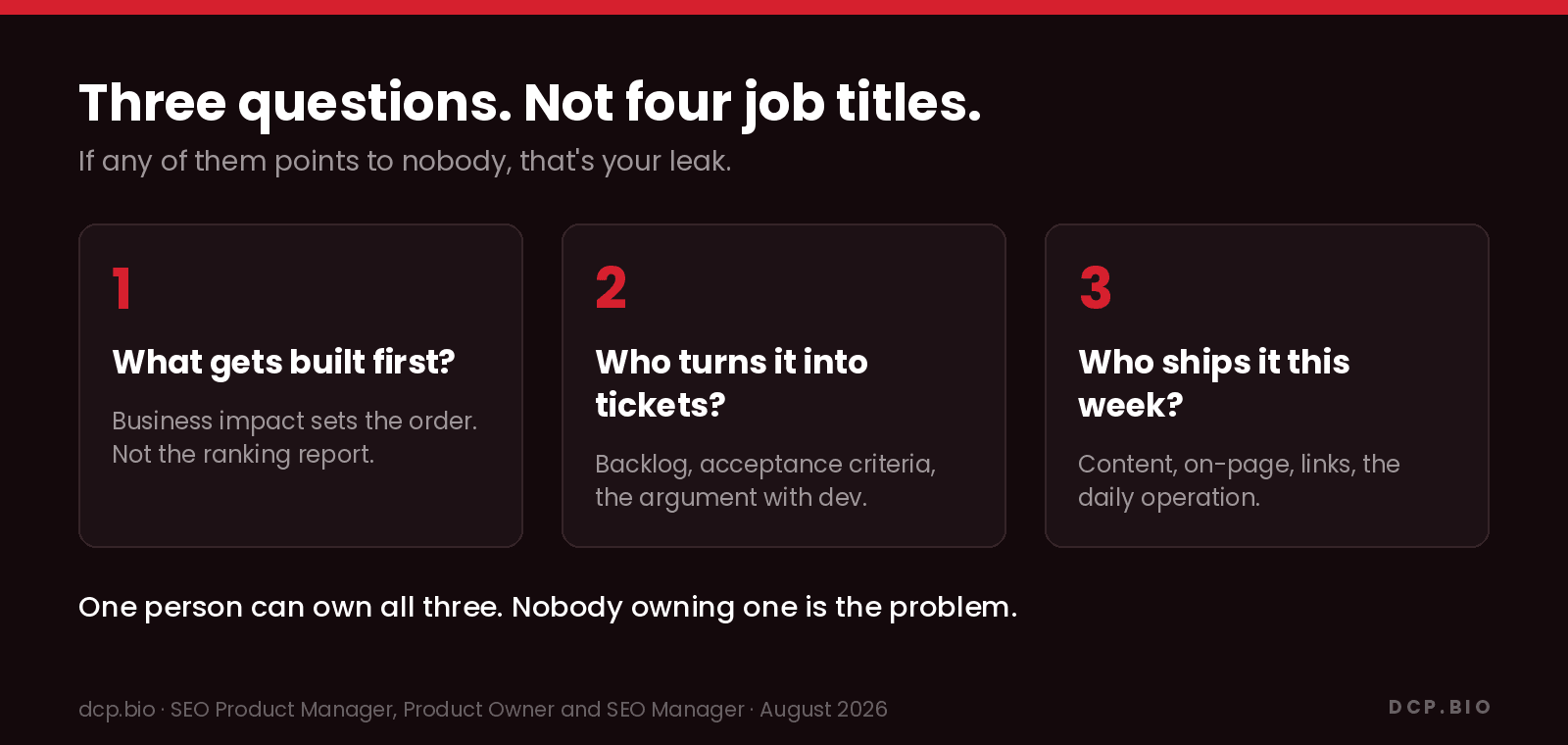
Practical rule so you don’t go round in circles: stop counting titles. Count how many of these three questions have an owner with a first and last name. What gets built first. Who turns it into tickets and fights for them. Who makes it ship. If all three point at the same person, you have a healthy small company. If any of them points at “nobody”, there’s your leak.
Which role your team needs right now
Depends on the stage you’re at. There’s no universal answer, there’s an answer by size.
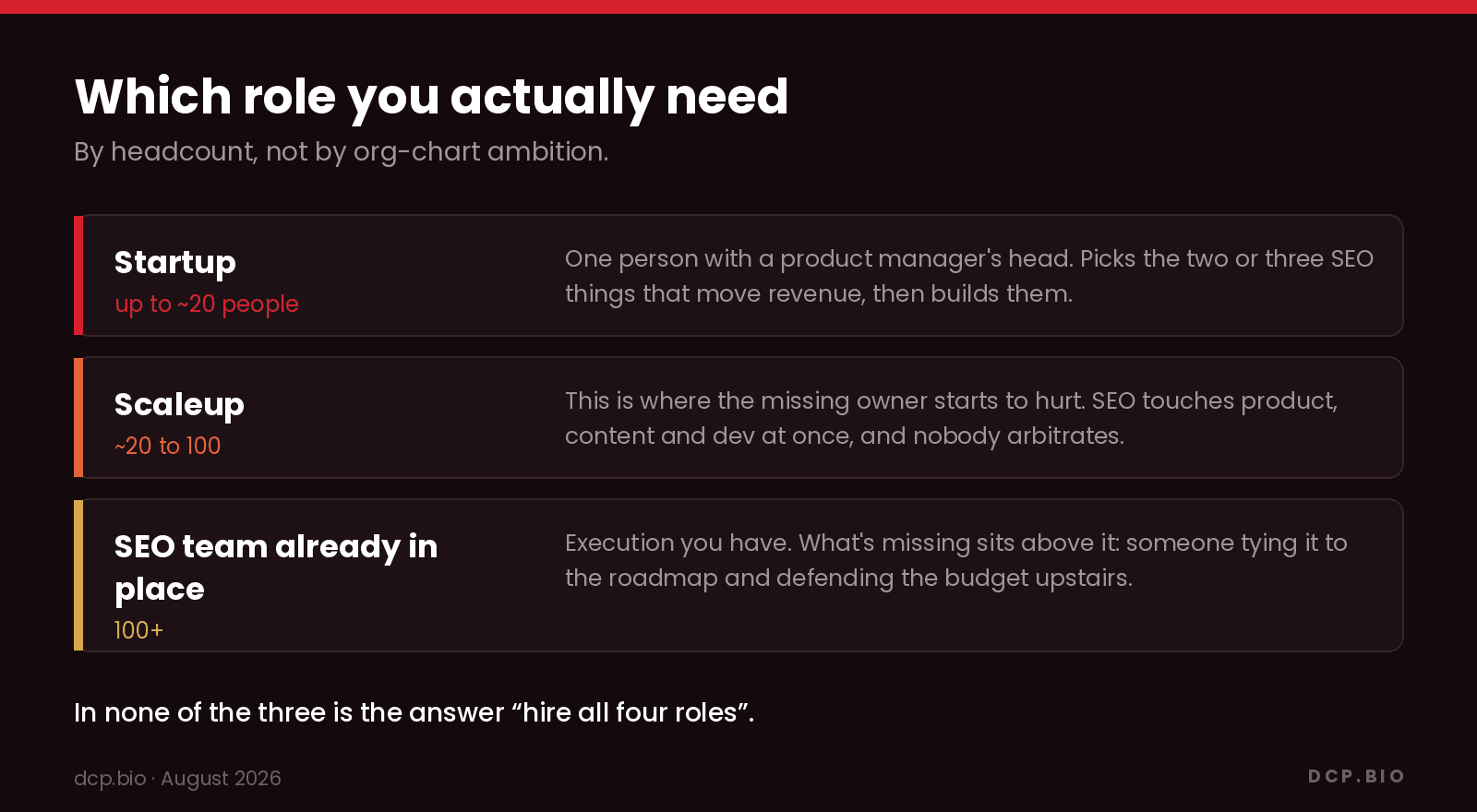
- Startup, up to about 20 people. You don’t need an SEO Director. You need one person with a product manager’s head who picks the two or three SEO things that genuinely move revenue and then builds them herself. A generalist with judgement beats a specialist in one layer.
- Scaleup, roughly 20 to 100. This is where the missing owner starts to hurt. SEO now touches product, content and dev at the same time, and without somebody playing Product Manager for it, each team prioritises it differently, or not at all. This is the moment for the role — and often the moment it makes sense fractionally, before the headcount exists.
- Company with an SEO team already running. You have SEO Managers executing. What’s usually missing isn’t more execution: it’s somebody above it connecting that work to the product roadmap and defending the budget upstairs. That’s where the Product Manager comes in, and the Director if the volume calls for it.
Notice that in none of the three is the answer “hire all four”. The answer is “make sure the three questions have an owner”, and in most companies that fits into one or two well-chosen people.
Frequently asked questions
What should an SEO Product Manager job description include?
Responsibilities written before the title, ownership of prioritisation against a product backlog, a measurement framework tied to revenue rather than rankings, and one explicit line saying who this person reports to and what they can overrule. If the ad can’t answer that last line, the role isn’t defined yet and the vacancy will stay open.
What’s the difference between an SEO Product Manager and an SEO Product Owner?
The Product Manager decides what gets built and why, looking at the business and the market. The Product Owner takes that decision and runs it inside the agile team: backlog, stories, sprints. One owns the what and the why, the other the how and the when. In small companies the same person does both.
Is an SEO Manager the same as an SEO Product Manager?
No. The SEO Manager coordinates and executes the daily operation: content, on-page, reporting, the team. The SEO Product Manager works a layer above, prioritising what deserves to be built based on business impact and getting it onto the roadmap. Plenty of ads ask for an SEO Manager while describing Product Manager or Product Owner responsibilities.
What does an SEO Product Manager do day to day?
Prioritises SEO initiatives by impact, connects them to the product roadmap, sits with marketing and with development, defines what gets measured and decides which initiatives stop. Less writing meta titles, more deciding what gets built before what, and why.
Which SEO role do I need for my company size?
In a startup, one person with a product manager’s head who prioritises and executes the few things that move revenue. In a scaleup, a clear owner of SEO connecting it to product and dev, internal or fractional. In a company with an SEO team already running, somebody above execution who ties it to the roadmap and defends the budget. Almost never the answer: hire all four.
Go back to that job ad. The role stayed open for three months because the name didn’t match the work. Change the title and the candidate appears. The title doesn’t matter. What matters is that somebody is accountable for SEO reaching the roadmap instead of dying in a ticket nobody picks up.
If you’re trying to work out which of these you actually need before you open a vacancy, tell me about your setup. 30 minutes, no pitch.