

Última actualización: 22 de November de 2026
A concept for international SEO in AI search, with data from Spain, Mexico and Argentina, and a method to measure it in any market that shares its language with others.
In 30 seconds
- What it is: AI answers in the user’s language, as if it were local, but cites sources written for another country and doesn’t say so.
- How often: on product questions from Mexico and Argentina without naming the country, 34 of 36 Google AI Mode answers cited Spanish sites. None said so.
- Where it doesn’t happen: car insurance, with 0 Spanish sources and 95% local ones.
- It even leaks into the words: robot vacuum answers that cited Spanish sites used Spain’s word for mopping (fregar, fregona) in 16 of 23 cases, even when the user had written Mexico’s trapear.
- How to measure it: seven steps, four metrics, and a template and data to download at the end.
I asked Google AI Mode, from Mexico City and in Spanish, for the best value robot vacuum. As the budget pick it recommended a Cecotec Conga, from a Spanish brand, at an approximate price of “90€ – 170€ depending on deals”. The source for that figure was El País’s shopping section. At no point did the answer mention Spain.
It isn’t a one-off. In the same test, 17 of 18 robot vacuum answers from Mexico and Argentina cited Spanish sites, and none of them said so. I described the clearest form in this LinkedIn article: a coffee machine answer written with Mexican phrasing and every source from Spain.
The answer speaks to the user as if it were local, and its evidence still comes from another country. I call this surface localization.
What surface localization is
Surface localization is when an AI answer adapts its language or dialect to the user but takes its evidence from another market, and doesn’t say so.
Three conditions have to hold at once:
- The answer presents itself as local. It’s in the user’s language and isn’t addressed to another market. In its clearest form, it also uses the dialect of the user’s country.
- The evidence is foreign. The cited sources were written for another country, with its stores, prices and rules.
- There’s no disclosure. The answer doesn’t say where its evidence comes from.
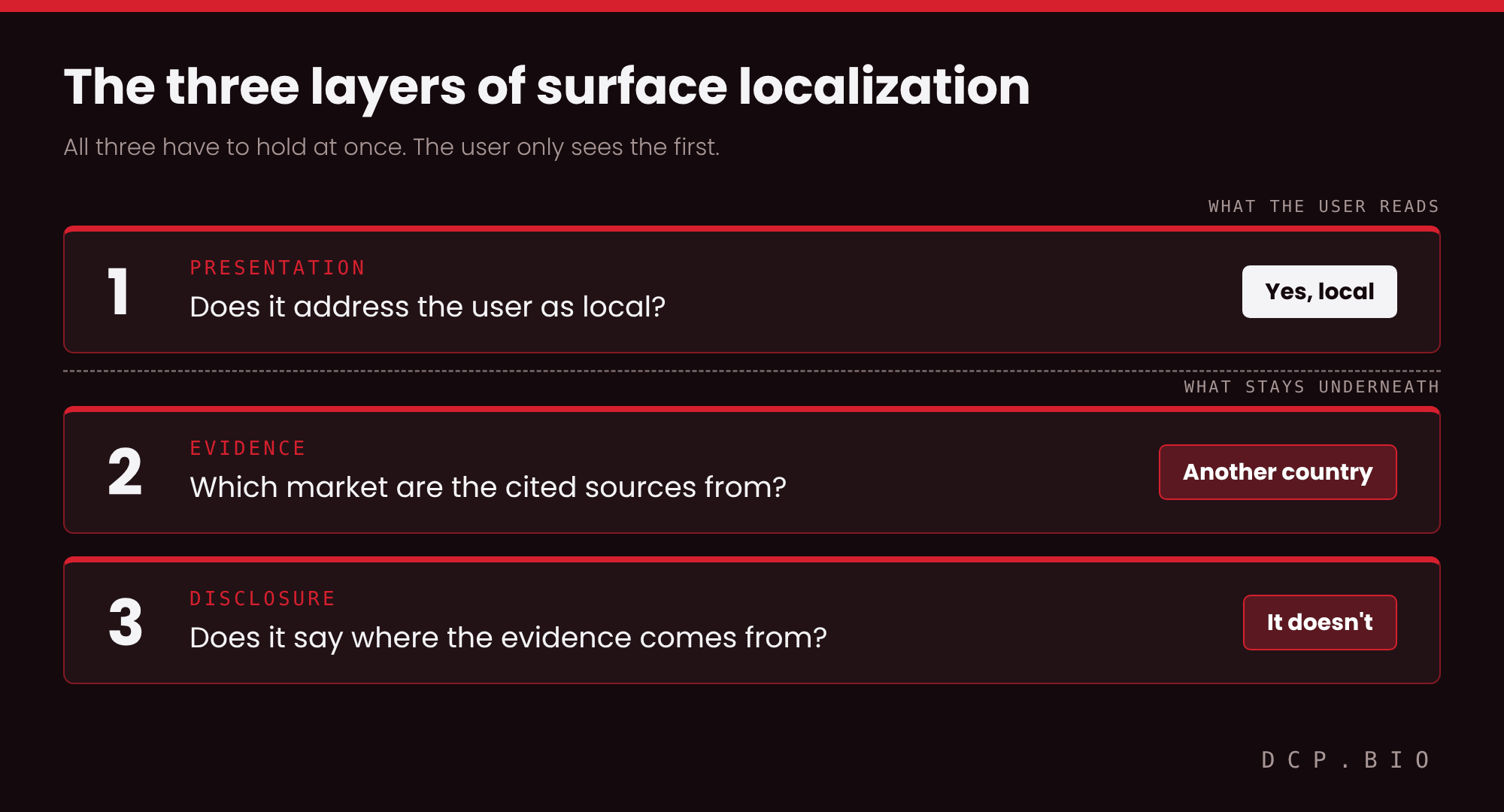
The user only sees the first layer. That’s why this failure is harder to spot than the ones it gets confused with:
- A framework error is visible. Ask from Mexico how to register as self-employed and get Spain’s tax regime back, and the content is useless. Anyone can tell.
- A dialect error is visible too. Spain’s word for computer in an answer for Mexico stands out.
- With surface localization, nothing in the text looks off. You only find it by opening the sources, and almost nobody does.
To measure it I propose one figure, the surface localization rate: the share of answers that cite at least one source from another market without disclosing it.
Three clarifications so the figure means the same thing in anyone’s hands:
- “Another market” means a source written for a specific country other than the user’s, judged by its currency, stores or regulation. A brand’s global site, an English source with no country, Amazon.com, YouTube or Reddit don’t count as foreign: they go into a separate “can’t be placed” bucket. In my replication that was between 5% and 15% of citations.
- The rate assumes condition 1 holds when the answer is in the user’s language. It doesn’t measure whether the dialect is the user’s country’s. There’s a first coding of the dialect further down, and what it shows is telling.
- “At least one source” is a generous threshold. So I also give a strict version: answers where foreign sources outnumber local ones.
In my Google AI Mode replication, for product questions asked from Mexico and Argentina without naming the country, the rate was 34 of 36 answers. In the strict version, 29 of 36.
What we already knew
This has precedents, and it’s worth separating what had already been said from what this data adds.
Motoko Hunt described what she calls “geo drift” in Search Engine Journal in November 2025: answers that look localized on the surface and are built from another market’s data underneath, “English data wearing a different flag”. It’s the closest reference, but it describes a different problem: English content presented in another language. Surface localization is the case where the language already matches: same language, a different country and no disclosure. Hunt already warned that a Spanish query could come from Mexico, Colombia or Spain, reported a test by Blas Giffuni in which a search for industrial suppliers in Mexico returned a translated US list, and suggested logging which markets AI-cited sources belong to. Her focus is English leaking into other languages, and the piece doesn’t include a systematic measurement.
On the research side, a Google Research and Bar-Ilan University team published “Location Not Found” at ACL 2026. It separates linguistic fluency from localization and shows, with 2,156 locale-ambiguous questions in 12 languages, that models default to US norms even when asked in another language. Veselovsky and colleagues describe an “explicit–implicit localization gap”: the model has the local knowledge but doesn’t use it unless asked explicitly.
On the sources side, the closest work comes from German-speaking markets. Working with Stellarcast data, Ulrike Langer showed in News Machines that when you ask in English, German outlets disappear from most answers. In Zurich, the fög (in German) measured the reverse: when the question names Switzerland, Swiss media become the most-cited source. And Gianluca Fiorelli has long argued that LLMs confuse language with location, and flags a Spanish-language site serving both Spain and Mexico as a common risk.
What this work adds is defining that case and measuring it. Fiorelli flags it as a risk. As far as I know, this is the first measurement of the same-language, cross-country case, in the sources AI cites when it searches (not in what the model “knows”), with the non-disclosure condition, and compared against what Google shows for the same question.
There’s one contrast I find the most interesting, with a caveat: it doesn’t measure the same thing. The Google paper looks at what the model knows, and I look at what it retrieves when it searches. There, bias among countries sharing a language tracks population size. In retrieval, my data points the other way: Mexico has almost three times Spain’s population and its sources still lose. My hypothesis is that when AI searches, population isn’t what decides. What decides is who publishes the format AI wants to cite.
Where this comes from
The idea didn’t come from a single study:
- March, in Search Engine Land: the Global Spanish problem. AI treats more than 20 markets as one.
- April: a cultural SEO framework. When content doesn’t state its market, the model fills the gap with a default.
- May: Catalonia shows that source pools split by language.
- October: the poster at Search Central Live Deep Dive Europe. Of 76 answers from a Mexico context, 16 developed another country’s framework and 9 more never settled which country they meant. And an experiment with ChatGPT’s background searches (post in Spanish): they search where the model thinks authority lives, not in the user’s language.
- November: the Stellarcast study and this article’s replication. With neutral products, the failure no longer shows in the text.
The evidence
1. A replication across three categories
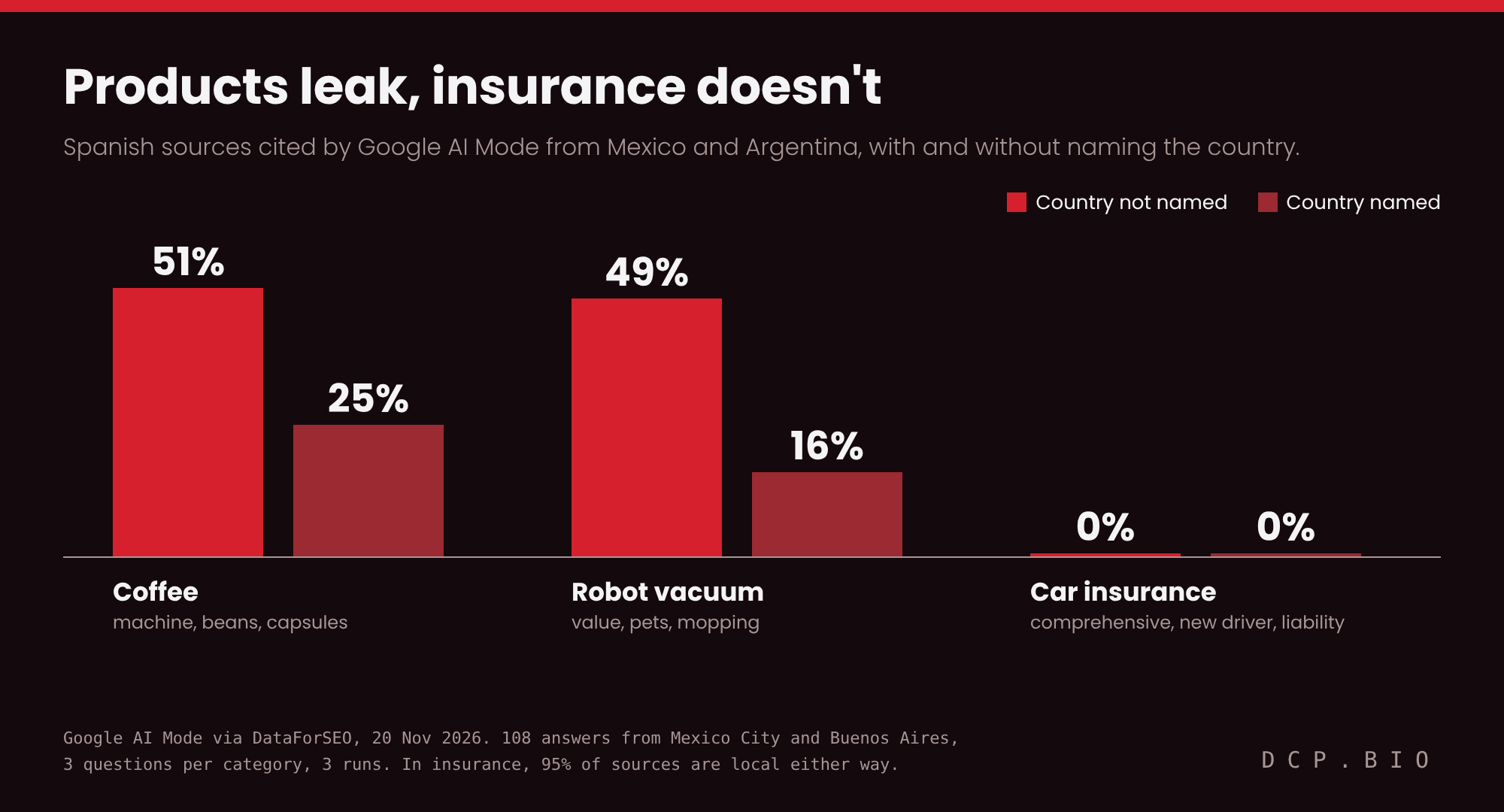
On 20 November 2026 I ran 162 queries through Google AI Mode with DataForSEO, from Madrid, Mexico City and Buenos Aires. There were three categories with three questions each, with and without the country in the prompt, and three runs. Prompts used each country’s own vocabulary: robot aspirador, seguro de coche and que también friegue in Spain. Aspiradora robot, seguro de auto and que también trapee in Mexico. And aspiradora robot, seguro de auto and que también pase el trapo in Argentina.
| From Mexico and Argentina | Spanish sources, no country | Spanish sources, country named | Local sources, no country |
|---|---|---|---|
| Coffee | 39 of 77 (51%) | 22 of 87 (25%) | 15 of 77 (19%) |
| Robot vacuum | 36 of 73 (49%) | 12 of 73 (16%) | 13 of 73 (18%) |
| Car insurance | 0 of 82 (0%) | 0 of 75 (0%) | 78 of 82 (95%) |
What it shows:
- The pattern holds beyond coffee. From Mexico City, without the country named, none of the 35 sources cited on robot vacuums was Mexican. The 13 local sources in the table all come from Buenos Aires.
- For products, naming the country reduces the leak but doesn’t fix it. The rate drops from 34 of 36 answers to 17 of 36, and for coffee one citation in four is still Spanish. This qualifies what we reported from the Stellarcast study, where naming the country left Spanish sources in 2 of 72 answers. But the questions naming the country there were different (subscriptions, where to buy freshly roasted coffee, roasters, sustainable brands) and ran on three engines. Here they’re product questions on AI Mode only. My reading is that naming the country works very well when the question is already local, and falls short when the product is sold everywhere.
- Insurance doesn’t leak. It isn’t the vocabulary, which I used for robot vacuums too. My hypothesis is jurisdiction: there are local insurers, local comparison sites and public bodies with their own content, such as Mexico’s Condusef, which gets cited again and again.
- None of them disclose it. Of the 51 answers from Mexico and Argentina that cited Spanish sites, none mentioned Spain.
2. AI doesn’t inherit Google’s leak, it changes it
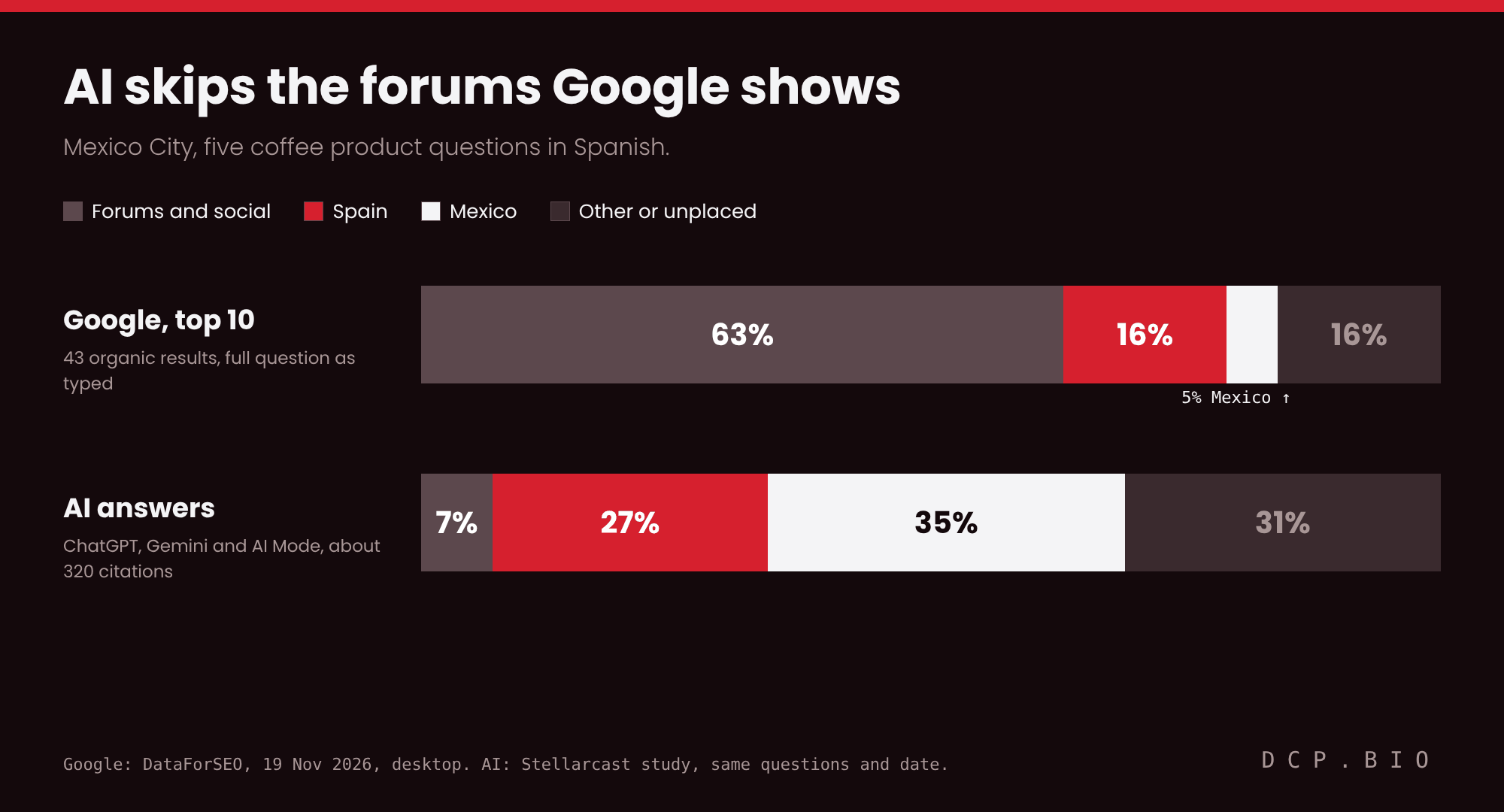
Gemini and AI Mode draw on Google’s index, so on 19 November, the same day the Stellarcast study answers were collected, I pulled 30 results pages with DataForSEO for its five coffee product questions.
With the full question typed from Mexico City, Google already showed more Spanish editorial results than Mexican ones: 7 against 2 across the five questions. But most of the page was forums and social platforms: 27 of 43 results.
The study’s AI answers (ChatGPT, Gemini and AI Mode together) do something else. Only 7% of their citations in Mexico came from forums and social platforms, and of 85 Spanish citations, only 21 came from domains in Google’s top 10 for that question. In Argentina, 0 of 90. The AI doesn’t copy Google’s leak. It searches further and brings in Spanish sources with more authority than the ones Google shows.
3. The Stellarcast study
Somya Goyal and I analyzed 1,065 answers from four engines to 14 coffee questions. Three figures from that study fit the definition:
- On product questions without the country, 29% of the sources cited from Mexico and Argentina were Spanish. On local-business questions, 2%.
- 119 of 175 of those citations were the exact URLs cited from Spain.
- 1 of 69 answers citing Spanish sites mentioned Spain.
The other figures and the method are in the full report.
4. The leak gets into the words too
To check condition 1, I coded the dialect of the answers from Mexico and Argentina with a simple lexicon. As Spain markers I used fregar, fregona, fregado (mopping), coche (car), ordenador (computer) and vosotros. As local markers, trapear, auto, celular and computadora in Mexico, and the voseo (tenés, querés, podés) in Argentina.
Coffee has almost no words that change between countries, and most answers come out neutral. For robot vacuums, where Spain says fregar and Mexico says trapear for the same thing, the sources’ vocabulary beats the user’s:
| Robot vacuum answers from Mexico and Argentina | Use Spain’s words |
|---|---|
| Cite Spanish sites | 16 of 23 |
| Don’t cite Spanish sites | 2 of 13 |
Even when the question said que también trapee, several answers mixed trapear with fregona. In Argentina, some answers used the voseo and fregado in the same sentence: the user’s grammar and the source’s words.
This refines the definition. Surface localization isn’t always a perfect local layer on top of foreign evidence. Often the surface cracks too, and through the cracks you can see where the sources come from. It’s a small lexicon applied to 36 answers in one category, so I take it as a lead to measure better, not as a settled figure.
My reading of all four is the same: this isn’t a bias towards Spain as a country, it’s a bias towards a format. “Best X” buying guides with affiliate links are mostly produced by Spanish media. Where that format dominates, as with products sold everywhere, Spain wins. Where jurisdiction dominates, it doesn’t.
How to measure it in your market
The method is meant for any language shared by several countries. I’ve tested it in Spanish. Catalan and the German Stellarcast case serve as contrasts, since they show the role of language and location, but not leakage between countries that share a language. The template at the end has every column.
1. Write three kinds of questions. Global product (sold the same way everywhere), local business (depends on where you are) and jurisdiction (has its own rules: insurance, tax, paperwork). Use each market’s vocabulary.
2. Run each question with and without the country, from each city, three times. Answers change between runs.
3. Classify each source by reading the site, not the domain. Look at currency, stores, phone numbers and regulation. Log the sources you can’t tie to a country separately, and report them.
4. Calculate four metrics:
- Surface localization rate: answers citing at least one source from another market without disclosing it. Reference: 34 of 36 for product questions without the country (replication, AI Mode only, 20 November). Strict version: 29 of 36.
- Foreign-source share, by question type. Reference: 29% for product questions and 2% for local business (Stellarcast study, ChatGPT, Gemini and AI Mode, Spanish-language answers from Mexico and Argentina).
- URL overlap with the dominant market. Reference: 119 of 175 (Stellarcast study).
- Named-country effect: the difference with and without the country. It tells you whether one word fixes the problem or whether it’s structural.
5. Compare with Google. Pull the top 10 for the full question and for the short keyword, and compare them with what the AI cites. They give very different pictures: in my data from Mexico City, forums and social platforms dropped from 27 of 43 results with the full question to 16 of 47 with the short keyword, and Mexican results rose from 2 to 5. Looking at only one gives you half the picture.
6. Check how the foreign sources declare their market. Look at the hreflang and page language of the most-cited ones. In my case, the three Spanish guides cited most for coffee machines looked like this:
| Guide | hreflang | Page language |
|---|---|---|
| La Vanguardia, /comprar/ | None | es |
| ABC, /favorito/ | None | es |
| ¡Hola!, /seleccion/ | es | es |
None of them declares that it’s written for Spain. An es-ES tag probably wouldn’t change much, since retrieval works on meaning. But without it, the model gets no explicit market signal at all.
7. Run the cart test. Look for the recommended products in the stores of the user’s market. For the coffee machine question from Mexico, only 2 of the 7 recommended models showed up with a price on Amazon México. It’s the fastest way to explain this to a client or a newsroom.
For answers with city-level location I used Google AI Mode through DataForSEO.
What to do with the result
- Local publisher: the gap is usually format, not information. If your market has no buying guides with local stores and prices, someone from abroad will fill that spot.
- Dominant-market publisher: you’re getting visibility where you probably can’t monetize it. Declare who each guide is for.
- Brand: your AI visibility in one country may partly be your press coverage in another. Measure by market, with and without the country, before trusting a visibility report.
If your site serves several countries in the same language and Spain is one of them, I cover the market side in SEO in Spain for foreign companies.
The Spanish version of this page declares hreflang “es”, not “es-ES”. I write from Spain, but the method applies to any Spanish-speaking market.
Limits
- The replication is Google AI Mode only, one day, three questions per category and three runs. It doesn’t include ChatGPT or Gemini.
- Between 5% and 15% of the sources cited from Mexico and Argentina couldn’t be tied to a country (15% for robot vacuums, 14% for coffee, 5% for insurance). They count as neither local nor Spanish.
- Domains were classified by hand, by one person.
- The Google comparison is one desktop results page per query, on a single day, for coffee only.
- The Stellarcast study covers coffee and one collection round. Perplexity had no location.
- The cart test is one search in one store.
- The dialect coding uses a small lexicon and is only informative in categories where words differ between countries.
All of this shows a mechanism and when it appears, not a rate for every sector.
Data and template
- Audit template (CSV).
- Google AI Mode replication, 20 November 2026 (CSV, 734 citations).
- Replication, one row per answer (CSV, 162 answers, with dialect coding).
- Google SERPs, 19 November 2026 (CSV, 30 results pages).
- Stellarcast study report.
The data is released under CC BY 4.0: you can reuse and adapt it with attribution.
The rest of my research on markets that share a language is on the research page. For the wider picture across Spain, Latin America and the US Hispanic market, see my Spanish SEO guide.
To cite this work: Carrasco Pamies, D. (2026). Surface localization: AI answers in your Spanish and cites another country. dcp.bio. https://dcp.bio/en/surface-localization/
If you measure this in your market, I’d like to see the results. Especially if you find a product category where it doesn’t happen.